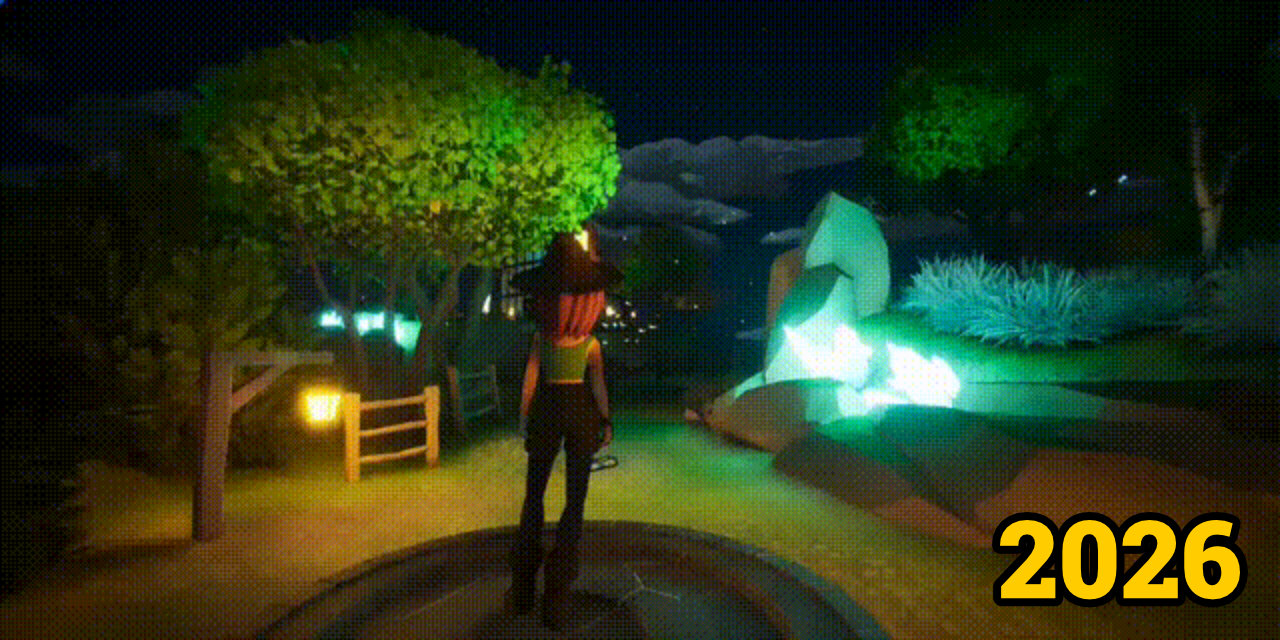
Hey everyone! I wanted to take a minute to do a retrospective on my previous game project: A Witch’s Path.
I started A Witch’s Path in December 2024. I just started as a full-time indie dev, switched to Unreal Engine 5, and I had no idea what I was doing 😁. Looking back now, I think it’s worth talking about the full experience and what I learned from it.
What Went Wrong?
This question stumped me for a long time, because on paper I thought I was doing everything “right”:
- Reduced scope from the original concept.
- Chose a hyper-stylized art style that fit with my own style.
- Used third-party asset packs to supplement custom art.
While the game came out looking pretty good, in the end, the game just wasn’t fun to play.
Here are the three big mistakes I made:
- Chose an unfamiliar genre: The Cozy Trap
- Iterated too much on UI: UX Uncertainty
- Invested too much time in a prototype: Prototype vs Demo
The Cozy Trap
This was the biggest blunder of the whole project.
As a gamer, I don’t play that many cozy games. I like Souls games, RPGs, FPS, action-adventure… that kind of stuff. So why did I decide to build one?
This was going to be the first “official” game I built. I’ve made lots of prototypes before, but nothing I’ve ever released or felt proud of. That created a lot of self-doubt when it came time to design a real game. Before I even started, I was already thinking:
- I can’t make a full combat game
- I can’t make a big story
- I can’t make a game full of NPCs, animations, VFX, etc.
So I kept reducing scope. Eventually, I was left with a shell of what I actually wanted to build. That’s when I got the idea: What if I make something cozy? Something small that gives good vibes.
Here’s the problem with that approach: Most cozy games live and die on content. Some have lots of mechanics, some don’t, but all of them rely heavily on scripted moments and handcrafted experiences to keep players engaged.
Meanwhile, I was trying to build a game that leaned heavily on emergent gameplay, minimal scripting, and a heavy focus on systems and mechanics. So even though I called it a cozy game, I was still secretly designing something closer to a systems-driven RPG.
That mismatch hurt the project from the start.
UX Uncertainty
Since my game relied so much on mechanics, I knew I needed something interesting at its core. I decided to build a Spell-Crafting system.
The idea sounded fun: Gather materials from the world and combine them into spells.
I actually had a working version of the system in a couple weeks. It pulled items from the player’s inventory, mapped them to a spell, and spawned the effect in-game. Then I spent two months working on the Inventory and Spell-Crafting menus. Why? Because I was afraid players wouldn’t “get it” without good UX.
Here’s the real mistake: I never validated whether the Spell-Crafting system was actually fun before investing all that time into the UI.
The system should be fun before it’s explained well. And since I knew the system in and out, it should have been fun for me.
I trapped myself in a loop of:
Players won’t understand this → I need better UX → I can’t test the system yet
So instead of testing gameplay, I polished menus.
Prototype vs Demo
This one hit me hard. Because this was my first “real” game, I didn’t fully understand the difference between a prototype and a demo in my own work.
Part of this comes from how my brain works. I’m autistic, and I think in terms of systems and completeness. That’s been great for my software development career, but it’s caused problems in my game projects.
I couldn’t imagine validating my core loop (Spell-Crafting) without:
- All the supporting mechanics
- The UI
- The surrounding systems
So instead of building a small test, I built a whole game-shaped prototype. In the past, this pattern usually ended with me abandoning the project. This time, because I was full-time indie, I pushed through.
I spent about six months building a prototype while I thought I was building a demo. And all of it was on top of shaky foundations.
What’s Next?
For now, A Witch’s Path is on hold. I’m currently working on a new game called Arden Card, which is very different and heavily informed by everything I learned in 2025.
But this isn’t the end of A Witch’s Path.
While building the prototype, I created a lot of lore, characters, and story within my fantasy world. Even though it won’t be for a while, I do plan to revisit it someday.
When I do, my goal will be simple:
- Build something I actually enjoy
- Stay true to the world and its identity
- Design mechanics that fit the genre I’m aiming for
These were the toughest realizations to have, but without them, I would never be able to build anything real or fun.